When you buy through links on our articles, Future and its syndication partners may earn a commission.

NASA's Artemis 2 astronauts have witnessed one of the rarest sights in spaceflight history — a total solar eclipse from beyond the moon.
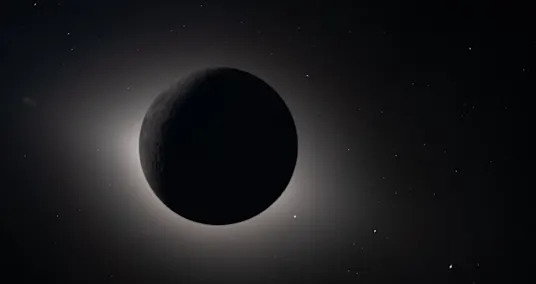
The event unfolded yesterday (April 6) as the Orion spacecraft looped around the far side of the moon. This trajectory placed the crew in the right place at the right time to see the moon completely block the sun for about 53 minutes, which is far longer than the maximum period of totality for eclipses seen from Earth.
But it wasn't just the duration that made this eclipse extraordinary; it was the view.
NASA astronaut Victor Glover described the scene unfolding as the sun vanished behind the lunar disk.
"This continues to be unreal. The sun has gone behind the moon and the corona is still visible. It's bright and creates a halo almost around the entire moon," Glover said.
As darkness fell, another phenomenon quickly emerged. "When you get to the Earth side, the earthshine has already shown … almost seconds after the sun sets behind the moon, you can see earthshine," he added.
From Orion's windows, the crew was able to make out the faint glow of sunlight reflected off Earth, while stars and planets appeared in the background. The moon itself became a stark silhouette: "This black orb out in front of us," as Glover described it, edged by the glowing solar corona.

Though a rare sight, it's not the first time a solar eclipse has been viewed from lunar realms. The Apollo astronauts, who orbited the moon rather than flew by it (as Artemis 2 did), also saw solar eclipses, NASA's Kelsey Young, Artemis science flight operations lead, said during a press conference on Saturday (April 4).
The eclipse marks just one highlight in an already historic mission. Artemis 2 is the first crewed journey to the moon since Apollo 17 and has already set a new distance record for human spaceflight.
Following their impressive lunar flyby, the astronauts are now heading back toward Earth and are expected to splashdown on Friday (April 10) off the coast of San Diego.
LATEST POSTS
- 1
 Exploring Programming Greatness: A Survey of \Easy to use Connection points\
 - 2Kiev declares energy emergency after Russian attacks amid winter cold
- 3Falcon 9 rocket launches Starlink satellites before making 550th SpaceX landing (video)
- 4Father and son spending Christmas together after health scares
- 5German Court Rejects Bid To Force BMW and Mercedes-Benz To Stop Selling New Combustion-Engine Cars After 2030



- NASA's Artemis 2 moon launch may be visible from Florida and southern Georgia today. Here's when to look
- Kaiser Permanente affiliates to pay $556 million to resolve US claims alleging Medicare fraud
- The most effective method to Pick the Right Teeth Substitution Choice for You
- These men carry towers of birds through Mexico's streets. They say their tradition is dying out.
- Selena Quintanilla documentary 'Selena y Los Dinos: A Family's Legacy' is coming to Netflix
- KJ Apa stars as Jimmy Stewart in new biopic: See his transformation
- Manual for Notorious Fragrances: Immortal Aromas
- German journalists' union condemns attack on reporters in village
- Remain Cool and Solid: Top Summer Food sources for 2024