MADRID (AP) — Noelia Castillo, a Spanish woman who sought euthanasia and fought a protracted legal battle with her family over her right to do so, received life-ending medicine on Thursday in Barcelona. She was 25.
EDITOR’S NOTE — This story includes discussion of suicide. If you or someone you know needs help, international helplines can be found at www.iasp.info/suicidalthoughts.
For a year and a half, Castillo pursued her right to die after her father put up a lengthy legal battle when a medical body in Catalonia approved his daughter’s request for euthanasia in 2024.
As the family's struggle unfolded, Castillo’s case was closely followed in Spain, which passed legislation in 2021 enshrining the right to euthanasia and medically assisted suicide for patients meeting certain conditions. Castillo's young age, the public battle waged by her family to stop her and the circumstances that led her to seek euthanasia animated public opinion as the courts ultimately ruled in favor of her right to end her life.
“At last, I’ve managed it, so let’s see if I can finally rest now,” Castillo told Spanish broadcaster Antena 3 in an interview that aired Wednesday, a day before her death. "I just cannot go on anymore."
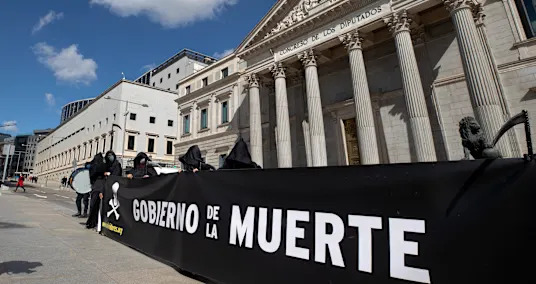
Castillo's parents opposed her decision up until the end, and were represented by the conservative Catholic organization Abogados Cristianos in their fight to stop their daughter's euthanasia. The Catholic group on Thursday confirmed that she had died.
Attorney Polonia Castellanos said Castillo's family was deeply disappointed with the outcome, and believed the Spanish government had abandoned and failed their daughter by allowing her to die.
“Death is the last option, especially when you’re very young,” Castellanos said.
A lengthy legal battle
Castillo tried taking her life twice before her death by euthanasia on Thursday, she said, the second time after she was sexually assaulted. The injuries she suffered from her second suicide attempt in October 2022 left her unable to use her legs and in a wheelchair.
In April 2024, Castillo solicited euthanasia with an independent body in Catalonia made up of doctors, lawyers and bioethics experts who deliberate on the application of Spain’s law.
The body approved Castillo’s request based on assessments that evaluated her condition as serious and incurable, and that the 25-year-old had severe, chronic and debilitating suffering.
Spain legalized physician-assisted suicide and euthanasia in 2021 for long-suffering patients from incurable diseases and for people with unbearable permanent conditions. The process for patients to get approval to die involves submitting two requests in writing followed up by consultations with medical professionals not previously involved in the case.
Castillo’s father appealed the Catalan body’s decision, which in August 2024 suspended the euthanasia request while it deliberated. Through Abogados Cristianos, Castillo's family argued that she suffered from mental illness that rendered her incapable of making the decision to end her life.
When the Barcelona court ruled in favor of Castillo's right to euthanasia, her father's lawyers appealed again, taking the case to Spain’s Supreme Court, which in January upheld Castillo’s rights. Abogados Cristianos tried to halt the procedure again by appealing to the European Court of Human Rights, which earlier this month denied the request to put it on hold.
On Thursday, Castellanos repeated her client's arguments that Castillo had a personality disorder and held up Castillo's case as an example of the law failing citizens.
“It is a person whose will (was) altered by that disorder,” Castellanos said. “I think this is proof of the failure of the law and that it has to be urgently repealed.”
Castillo's final wishes
Speaking to Spanish TV Wednesday, Castillo said she did not want her family to be around when she died, claiming that she was misunderstood. She acknowledged the glaring media spotlight that her case had drawn.
“None of my family is in favor of euthanasia, obviously, because I'm another pillar of the family," she said, adding, “but what about the pain that I've suffered all of these years?”
Spain is among nine European Union countries that have laws allowing those experiencing unbearable suffering to access assisted dying, according to Dignity in Dying, a U.K.-based rights group that advocates in favor of euthanasia and medically assisted dying. That involves patients themselves taking a lethal drink or medication that has been prescribed by a doctor to patients who meet certain criteria. The criteria vary by country.
Euthanasia, on the other hand, involves doctors or health practitioners, under strict conditions, actively killing patients who meet certain conditions by giving them a lethal injection at their request.
Since Spain adopted its euthanasia law, 1,123 people have been administered life-ending medicine up until the end of 2024, according to Spain's Health Ministry.
Castillo said she never questioned her decision as she had to reassert her desire to die over the past year and a half. The calculus for her was simple.
“The happiness of a father or a mother should not take precedence over the happiness or the life of a daughter."
LATEST POSTS
- 1
 She's been a Bond girl and a mutant. Now she's grappling with Hollywood's obsession with 'eternal youth.'
 - 2NASA's Artemis 2 moon launch seen from space | Space photo of the day for April 2, 2026
- 3Moon rocket and weather are on NASA's side for the first astronaut launch in decades
- 4Iran, Hezbollah fire rockets at Israel during Passover celebrations
- 5Figure out How to Use the Experience of a Fender bender Legal counselor for Your Potential benefit





- How federal officials talk about health is shifting in troubling ways – and that change makes me worried for my autistic child
- IDF bans Android phones for senior officers, iPhones now mandatory, Army Radio reports
- Elvis Presley's Infamous Pantera Shooting
- Flu cases are rising with a strain that makes older people sicker
- Meet ‘NASA Mike,’ who’s done 105,000 handstands around the world
- Become the best at Discussion: 6 Procedures for Progress
- Tremendous Spelunking: Cool Caverns All over the Planet
- Exclusive-Drugmakers raise US prices on 350 medicines despite pressure from Trump
- Medical team successfully delivers baby and removes massive tumor


