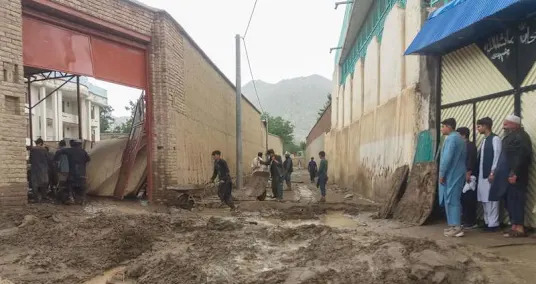
At least 61 people have been killed and 116 injured across Afghanistan since March 26 due to heavy rainfall, floods, landslides and lightning strikes, the Afghan government said on Saturday.
At least four people were still missing after floods affected thousands of families and damaged 2,448 houses, Afghan government spokesman Zabihullah Mujahid said in a post on X.
In addition, thousands of hectares of cropland was also destroyed, posing serious risks to rural communities who rely on agriculture for their livelihoods.
Deadly flooding has struck Afghanistan repeatedly in recent years, causing significant loss of life, injuries and widespread damage to homes, infrastructure and agricultural land.
Extreme weather events such as flash floods and droughts are increasing in Afghanistan, which experts link to the climate crisis.
Despite having a negligible carbon footprint, the country ranks among the most climate-affected nations and remains ill-prepared to cope after decades of conflict, poor infrastructure and a struggling economy, compounded by recent earthquakes and severe flooding.
LATEST POSTS
- 1
 Fireballs and a full moon. Here’s how to see two celestial events this week
 - 2Make your choice for the sweet that transports you to its nation of beginning!
- 3Figure out How to Augment the Advantages of a Web-based Degree
- 4SpaceX launches Italian Earth-observing satellite to orbit on the 1st mission of 2026 (video)
- 5Iran war drives global fertilizer prices up, raising food cost fears


- Viable Correspondence: Building Solid Connections
- Best Getaway destination: Ocean side, Mountain, or City
- Step by step instructions to Advance the Eco-friendliness of Your Kona SUV
- The face is familiar, the name might not be. The king of "Hey, it's that guy!' roles is ready to show you his next act.
- Brazil Passes Law to Use Seized Bitcoin, Crypto to Fund Public Security Measures
- Finding Ideal Date Spots for Two or three Encounters
- How much would you pay to meet a Real Housewife? At BravoCon, the limit does not exist.
- Why the chemtrail conspiracy theory lingers and grows – and why Tucker Carlson is talking about it
- Exploring ways to reduce the impact of space junk on Earth