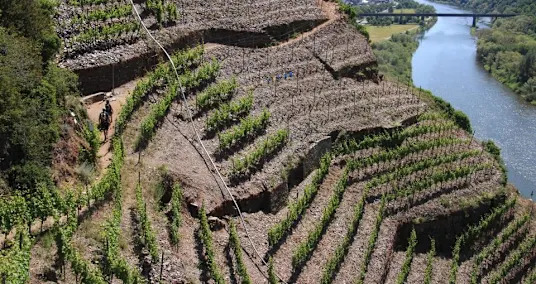
The sun sets slowly over the Mosel in mid-summer, glistening on the river that bends back on itself like a sentence that can’t decide where to end. The slate hillsides above Brauneberg—dark, almost violet in the fading light—have grown Riesling for two millennia. And yet, standing here in the warmth of what should be a cool summer evening, something is unmistakably different.
The harvest, once a late-October ritual, now arrives in mid-September. The frosts that once polished the Kabinett style into something impossibly delicate have started turning up in vineyards that hadn’t seen frost in living memory—in spring, when they can kill a bud. The Ahr floods of 2021 erased years of work in hours. This is climate change not as abstraction but as lived consequence, vintage by vintage, slope by slope.
“It’s not just getting warmer—it’s getting more extreme,” Oliver Haag, whose family has made wine at Weingut Fritz Haag in Brauneberg since 1605, tells me over dinner. “We had frost this year in vineyards that never get frost.” And yet Haag refuses to yield to pessimism. “In the Mosel, we are still in a good climate. We are learning and adapting quicker.”
That spirit of clear-eyed pragmatism is the defining posture of German viticulture right now. From the Mosel to the Rheingau, the conversation is the same: What can be controlled? What must be reimagined? And what is owed to the future?
The Provenance Shift
The answers, it turns out, are not straightforward—because the crisis has also, for now, been a kind of gift.
Thomas Ludwig, Deputy Chairman of the Regional Marketing Board of Mosel Faszination Wein and owner of Weingut Ludwig, puts it plainly: Over dinner in the Mosel—German Riesling paired, deliciously, with Thai food—he is direct: growers have profited from the ripeness the warming has brought. "In the 1990s, everything was average to good. Since 2000, every vintage has been good." He pauses. "But that's only up till now."
The region is also rethinking how it speaks to the world. Germany is completing a reclassification of its wine system—away from sugar levels at harvest and toward origin and terroir, similar to the Burgundy model, coming into full effect by the 2026 vintage. Oliver Haag welcomes it. “Each region can focus on their typical varieties,” he says.
“No more predicates for dry wines—it is a focus on terroir and vineyards, like Bourgogne. It will be easier to understand. “We think the character of Mosel is Riesling,” he says. We want to point out that what we make here comes from the steep slopes.”
But he acknowledges that rising temperatures will force government decisions about approving new varieties. Mosel’s iconic slate slopes, which for centuries gave Riesling its razor-edged acidity and impossibly light frame, are warming too.

"We think the character of Mosel is Riesling,” says Oliver Haag, owner and winemaker at Weingut Fritz Haag in Brauneberg.
gettyThe Science Behind the Vine
No one has more data on what’s actually happening than Dr. Manfred Stoll, Head of the Department of General and Organic Viticulture at Hochschule Geisenheim University. The institution—founded over 150 years ago and sitting on 36 hectares of research vineyards along the Rhine—has been recording temperatures, rainfall, and sunlight hours since 1883. “You can’t predict the future without knowing the past,” Stoll says, as we walk through a research vineyard during a summer heatwave.
What the past reveals is increasingly unsettling—carbon dioxide concentrations consistently climb every year. Geisenheim’s Free Air Carbon Enrichment (FACE) program—one of the longest-running field experiments on grapevines in existence, begun in 2014 with Riesling and Cabernet Sauvignon—has documented the consequences directly.
Elevated carbon dioxide levels accelerate photosynthesis — good news for biomass, less so for Riesling's tight clusters, where larger berries mean greater mildew pressure. Rainfall, Stoll notes, is now essentially unpredictable: warmer air holds more moisture, creating larger clouds, and then releasing them in violent events. The Ahr floods are his example.
Among Geisenheim’s most provocative responses is what Stoll calls “VitiVoltaic”—solar panels mounted above the vines on rotating frames. “Below are vines, above one installs a photovoltaic system,” he says as I crouch under a panel seeking reprieve from the blazing sun. “I like to call it ‘Back to the Future.’”
The panels shade the canopy, slowing sugar accumulation and extending the ripening window by one to two weeks. They reduce frost risk at night and capture rainwater for irrigation. In 2024, grapes harvested under the system showed lower sugar, higher acidity—ideal for Riesling.
The PiWi Promise—and Its Limits
If VitiVoltaics represent high-tech adaptation, the parallel push toward PiWis—Pilzwiderstandsfähige, or fungus-resistant hybrid grape varieties—is the bet on the vine itself. By crossing European Vitis vinifera with disease-resistant wild species, breeders have created varieties that can thrive with dramatically fewer fungicide applications.
Christian Ress, fifth-generation owner of Weingut Balthasar Ress in the Rheingau—the largest certified organic wine estate in Hessen—has been at the forefront of the experiment. His estate runs PiWi projects on the island of Sylt, Germany’s northernmost vineyard, and in the Rheingau.
“What people like about PiWis is they are environmentally friendly,” Ress tells me as we walk through the winery. However, he adds “we are not seeing PiWi grape varieties capable of producing great wines”—not at the level that defines the Rheingau’s identity. Not yet.
The more urgent case, in Ress’s view, is disease pressure in an era of unpredictable rainfall.
“If you produce wines far from the equator, seasons are becoming less predictable and weather is becoming more extreme,” he says. “Weeks of rain are very tricky for us, especially working organically. We need two and a half dry days every ten days or we start losing control. PiWi might be a solution for this.”
Thomas Ludwig frames the calculation in sustainability terms: “If each winery added just ten percent PiWis for everyday wines, we could save so much in spraying pesticides and fungicides that impact climate change. The main idea behind it is sustainability.”
Germany already offers three different certified sustainability systems for wineries to join, and Ludwig believes the key is clarity for the consumer. “The main aim is to have everything explained clearly on the label.”
Stoll goes further. Phytoalexins — the compounds that give these hybrids their natural disease resistance — may have applications as sprays to protect traditional vinifera varieties, further reducing chemical inputs across the entire industry. "When we look at the PiWi range, it's so huge," he says. "We can pick from the range and see what the future brings."
The Geisenheim breeding program is also developing entirely new varieties—among them Calardis Blanc, a disease-resistant hybrid already showing promise in field trials. The vine itself, it seems, is being rewritten alongside the rules.

As the warm summer sun sets on Bernkastel-Kues, a town on the Middle Moselle, questions arise about how to protect the future of Mosel viticulture from climate change.
gettyThe Long View
What strikes those who travels through the Mosel and Rheingau is the temporal confidence of the people making these decisions. "Our wineries come from the 17th and 18th centuries," Ress says. "We always think long term in everything."
Oliver Haag understands that Kabinett—the most tension-filled expression of Mosel Riesling, and one of its most beloved—is also one of the most climate-imperiled styles in Germany. "It is sometimes more difficult to produce now," he says. "But everybody has learned how to adapt."
Something counterintuitive is emerging from that adaptation. Vineyards once considered secondary—cooler exposures, north-facing plots, higher elevations—are becoming interesting for the first time. The warming that threatens Kabinett may yet rescue sites that were once too marginal to ripen. Ludwig has watched growers quietly buying west-facing slopes that were previously passed over. Climate change, it turns out, is not only a threat—it is redrawing the map of quality itself.
The weight of what is at stake is not lost on the people holding these vines. Haag looks out over the Brauneberg slopes—dark slate, steep and ancient, warmed now in ways his ancestors never knew—and finds a way to hold it all at once.
"The character of what we make here hasn't changed," he says. "Our approach to getting there has."
More From Forbes
MORE FROM FORBESMosel Winegrowers’ Focus On Soil Health Improves Wine QualityBy Michelle Williams


This article was originally published on Forbes.com
LATEST POSTS
- 1
 Turkey, Egypt, Qatar discuss second phase of Gaza ceasefire deal
 - 2The Ascent of the Kona SUV: How Hyundai's Reduced Hybrid Is Vanquishing the Streets
- 3Strength training is crucial after menopause. How to make the most of your workouts
- 4German politician urges more face-to-face interaction in digital age
- 5Minute Maid’s frozen juice concentrate is ending after 80 years — and so is a certain kind of kitchen ritual



- The Best Games On the planet
- Becoming Familiar with an Unknown dialect: My Language Learning Excursion
- Hundreds of Gazans evacuated from Strip for medical treatment - COGAT
- Step by step instructions to Streamline Your Dozing Involvement in a Savvy Bed
- Figure out How to Keep up with Oral Wellbeing During Pregnancy
- David Duchovny's new thriller has him stripping down at 65. But its chilling premise hits close to home.
- Favored Chinese Dish: Make Your Determination
- New images reveal interstellar comet 3I/ATLAS approaching Earth
- The Best 20 Tunes that Characterized an Age